


Updated 06.24.2026
Written by Reema Chande, edited by Rachel De La Merced and reviewed by Board Certified Psychiatric Nurse Practitioner Kate Filippelli, PMHNP who specializes in evidence-based psychiatry practices with personalized treatment plans for all mental health challenges, including psychiatric medication management, research-based supplements and behavioral interventions for major depressive disorder, bipolar disorder, anxiety, panic, OCD, ADHD and eating disorders.
It might be something you’ve heard of on a red carpet or in the news: beta-blockers as an anxiety treatment. This group of medications has become increasingly common with more mentions in pop culture. In an interview before a red carpet appearance, actress Rachel Sennott even described her pre-event routine by saying: “Take that beta-blocker, girl” [1]. On an episode of the reality show “The Kardashians,” Khloe Kardashian was describing the severe anxiety induced by paparazzi, talk show appearances, and online criticism. She proceeded to discuss taking one of Kris Jenner’s beta blockers to relieve this [2]. While these might be humorous comments about moments of high stress, her statement is reflective of a larger trend in the use of the medication. The prescription of this group of drugs for patients dealing with anxiety has been growing in recent years [3]. At Remedy Psychiatry, we often see patients come in asking about beta blockers after hearing about them in social or media settings, and we emphasize the importance of individualized evaluation before considering them as part of an anxiety treatment plan.
Above this article’s discussion of beta blockers and their offlabel use for anxiety treatment, it is crucial to understand that beta blockers are prescription medications that should not be taken without the direction of a medical provider and full understanding of the risks and benefits. It is especially not advisable to take any medications prescribed to someone else. The content of this article should not be read as medical advice.
What are beta blockers?
Beta blockers are relatively common oral prescription medications in the United States. You might have heard of their drug names, since most end in the suffix “-olol”. Medications like propranolol, metoprolol, and atenolol fall within this class of medications. These are primarily intended to treat heart and blood vessel diseases. Things like abnormal heart rhythms (also known as arrhythmias), abnormally high heart rate (tachycardia), tremors, aortic dissection (when the inner lining of the aorta separates from the wall of the blood vessel, causing blood to flow between the layers of the aorta’s wall), and glaucoma can be treated with beta blockers, and have been approved by the FDA for these purposes [4].
Those who search “what are beta blockers for?” are surprised to learn that these medications were originally developed for cardiovascular conditions rather than anxiety disorders. A beta blocker medicine works by affecting specific receptors in the body that influence heart rate, blood pressure, and the body’s response to adrenaline. Often, when other blood pressure medications do not work, beta blockers are an option for patients who are dealing with hypertension. These are considered the “on label” uses of beta blockers. Especially in the context of the topic of this article it is especially important to understand that off-label prescribing is widespread and legal. It typically happens when there are no other FDA approved medications for a patient’s specific condition and comorbidities, but offlabel prescribing also happens when other medications have not been benefiting a patient and a prescribing healthcare provider deems it safe and medically appropriate [5]. One example of this practice in psychiatry is the offlabel use of tricyclic antidepressants as a non-opioid treatment for chronic nerve pain (neuropathy) often caused by diabetes or cancer [6].
How do beta blockers work? What are they blocking?
When you take a beta blocker, the medication is blocking beta receptors in your body. There are different kinds of beta receptors around your body, designed for different functions. In the same way, there are different types of beta blockers designed to target each type or multiple types [7].
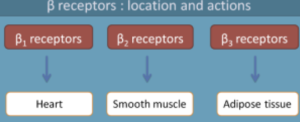
Most important for the topic of this article are beta-1 and beta-2 receptors. These are most commonly activated when the neurotransmitters epinephrine and norepinephrine (commonly known as adrenaline) are released into the bloodstream. While beta-1 receptors are mostly in the heart and kidneys where their activation leads to increased blood pressure, beta-2 receptors can be found anywhere where smooth muscles are found and work to relax them. Smooth muscles are what allow the body to push food through the digestive system, to excrete urine, and to expand and constrict blood vessels and airways in the lungs. Most beta blockers can be sorted into non-selective (inhibits both beta-1 and 2 receptors) and beta-1 selective (only inhibit the effects of beta-1 receptors in the heart and kidneys). Propranolol is one of the non-selective beta blockers, for example [4].
When you take a beta-blocker, the medication binds to these receptors instead of the epinephrine and norepinephrine and inhibits their effects. So, instead of increasing blood pressure, a beta blocker would decrease it, and instead of relaxing smooth muscles, a beta blocker would contract them. In general, beta blockers work to counteract the activation of the sympathetic, or “fight or flight” response.
If you are wondering if beta blockers work, the answer depends on the symptom being targeted. Beta blockers do not eliminate the thoughts associated with anxiety, but they can reduce many of the body’s physical stress responses. This is why some people describe beta blockers for stress and anxiety as helping them feel physically calmer during anxiety-provoking situations. In our clinical practice at Remedy Psychiatry, we often observe that beta blockers can be helpful for situational or performance-related anxiety, but they do not address the underlying cognitive or emotional drivers of chronic anxiety disorders.
Why do beta blockers get brought up in conversations about anxiety?
By disarming the beta-1 and beta-2 receptors that activate the sympathetic response in the body that often begins when we get anxious or stressed, beta blockers cancel out some of the physical symptoms of anxiety [8]. This can be beneficial for some people, especially in acute situations. For some, this might be a social setting or a specific performance that induces anxiety for a specific period, but not as much beyond it. Someone might take a beta blocker for stage fright, for example, as a way of decreasing heart rate, sweating, and blood pressure in advance of a performance. While anxiety is much more than a conglomeration of these symptoms, for some, controlling the peripheral physiological effects of anxiety is enough to make things more manageable in the short-term.
Who might this option be best for?
Because beta blockers seem to address primarily physical effects of anxiety, this may not be the best option for someone whose anxiety presents as persistent worrying or causes difficulties with falling asleep at night. People who get migraines are often better candidates for beta blockers, since they are FDA approved for migraine prophylaxis (prevention) [4]. The American Heart Association has shared research that beta blockers can sometimes be associated with sleep disturbances, and for some, this could mean worsened anxiety [9]. This is thought to occur because norepinephrine helps to regulate the circadian rhythm through its link with melatonin production. Blocking the receptors that would be activated by this neurotransmitter in turn has potential to disrupt sleep cycles, cause insomnia, and lead to nightmares. This could be concerning for patients with comorbid anxiety and PTSD.
People with asthma, diabetes, or low blood pressure may also be more sensitive to the adverse effects of a beta blocker, so they would not be ideal candidates either [8]. While some people might find beta blockers helpful in the moment, there is a potential for adverse effects, as with any medication. It is also possible that a beta blocker alone may not be sufficient as a treatment plan for someone’s anxiety, instead it may be prescribed alongside an antidepressant. This underscores the importance of consulting your medical provider before starting any new medications. As a psychiatric nurse practitioner at Remedy Psychiatry, I often observe that patients may initially prefer beta blockers because they feel less “psychiatric,” but many ultimately benefit from a more comprehensive approach that includes therapy and/or first-line anxiety medications when appropriate.
The Bigger Picture
Some argue that the rising popularity of beta blockers is partially due to its accessibility and the fact that it is not necessarily classified as a psychiatric drug, potentially reducing the stigma around psychiatric treatment. The increased attention surrounding beta blockers has also led to online discussions featuring statements such as “beta blockers cured my anxiety.” While some individuals report significant symptom improvement, anxiety disorders are complex conditions and treatment outcomes vary considerably from person to person.
Gonzalo Perez-Garcia, MD, a psychiatrist at the Texas Health Behavioral Health, a center in Dallas, describes this as a way of easing people into taking care of their mental health, despite the persistent stigma [8]. Not only could a beta blocker be more affordable or accessible, it might be easier for someone, especially those facing stigma around help-seeking, to say that they are on a blood pressure medication that also helps with their nerves than to pursue psychiatric treatment directly. This can then be a catalyst for future discussions about mental health issues and medical care, as well as continuing a larger research effort toward exploring the effects of these medications on mental health. At Remedy Psychiatry, we believe the best outcomes when patients receive a tailored combination of interventions rather than relying on a single medication approach.
References:
-
https://www.glamour.com/story/why-is-everyone-suddenly-using-beta-blockers-anxiety
-
https://www.womenshealthmag.com/health/a39825588/khloe-kardashian-beta-blocker/
-
https://www.sciencedirect.com/science/article/pii/S0165032724015532
-
https://www.ncbi.nlm.nih.gov/books/NBK532906/
-
https://www.fda.gov/patients/learn-about-expanded-access-and-other-treatment-options/understanding-unapproved-use-approved-drugs-label
-
https://www.mypcnow.org/fast-fact/tricyclic-antidepressants-for-pain/
-
https://www.egpat.com/blog/beta-blockers-a-central-role-in-cardiac-disorders
-
https://www.texashealth.org/areyouawellbeing/Behavioral-Health/Beta-Blockers-and-Anxiety
-
https://respiratory-therapy.com/disorders-diseases/sleep-medicine/insomnias/beta-blockers-may-contribute-to-insomnia-sleep-disturbances/